
What JetBrains Air reveals about defending a business when the capability at its centre starts moving elsewhere.
My last meaningful encounter with software development was a Java practical in high school. This is not the usual credential for writing about a new developer tool.
It may be useful here.
Many people still meet AI through a box. You ask ChatGPT, Claude or Gemini a question. It gives you an answer. If the answer is bad, you correct it or try again.
Software developers are already dealing with the next version of that relationship. Their AI tools can inspect an existing product, change parts of it, run tests, find mistakes and return completed work for review. The human does not need to perform every step by hand.
That changes more than how quickly someone can write code. It changes where the work begins, what the human remains responsible for and which company gets to own the space in between.
This is the strategic problem behind JetBrains Air.
First, what is JetBrains?
JetBrains is a long-established software company that makes the professional workspaces many developers use to build, understand and maintain software.
Think of a developer’s workspace as the room where the product is assembled. It holds the code, testing tools, project history and all the other machinery needed to stop a small change from breaking something important.
JetBrains built its business by making that room easier for developers to work inside.
Air, which launched as a public-preview product in March 2026, is the company’s response to a different kind of work. Instead of placing the developer at the centre of the workspace, it is designed around assigning tasks to AI coding assistants and reviewing what they bring back.
That difference sounds technical, but it really isn’t.
The work is changing faster than the workspace
There is now evidence that the human and the AI are beginning to divide the work differently.
Anthropic studied roughly 400,000 Claude Code sessions between October 2025 and April 2026. In a typical session, the person made around 70% of the planning decisions—what needed to happen—while Claude made roughly 80% of the execution decisions—how to do it. One human instruction triggered about ten actions from the AI on average. Anthropic describes this as a division between deciding what to build and deciding how to build it.
This is one company studying the use of its own product, so it should not be treated as a census of the entire profession. But it gives us a useful finding: developers can increasingly direct work that they would previously have carried out themselves.
JetBrains’ own January 2026 survey of more than 10,000 professional developers found that 90% regularly used at least one AI tool for coding and development work. Seventy-four percent had adopted tools designed specifically for software development. Standalone products such as Claude Code were also gaining professional adoption quickly.
This is JetBrains’ own market research rather than an independent census, so the figures are best treated as directional.
The question really isn’t whether AI will appear inside software development. Rather, I think it is where the developer will go first when there is work to be done.

Eadweard Muybridge, Attitudes of Animals in Motion, 1879, printed 1881. The Metropolitan Museum of Art. Public domain.
What JetBrains is actually defending
Until recently, the natural starting point was the developer’s main workspace. Open the project, understand the problem and begin making changes.
Now the task can begin somewhere else.
A developer can open OpenAI’s Codex, describe the outcome and let the AI work on a separate copy of the product. Several tasks can run at once. The developer returns later to inspect the changes and decide what to keep. OpenAI now describes its Codex app as a place for managing multiple agents, parallel work and long-running tasks.
That creates a quiet risk for JetBrains.
The company’s existing tools may remain respected and heavily used. But if the task starts inside Codex, Claude or another AI product, JetBrains risks becoming somewhere the developer visits afterwards—to inspect, repair or finish work that began elsewhere.
The workspace has now moved downstream. And for a company that built its position around where software work happens, that matters. Of course.
Air is a bet on the layer around the AI
JetBrains does not need to build the world’s most powerful AI model to respond. Air allows developers to use several competing coding assistants, including Claude Agent, OpenAI Codex, Google’s Gemini CLI and JetBrains’ own Junie. The developer can choose the assistant for each task.
Air then provides the surrounding system.
The developer can give the AI background information about the product, decide how freely it may act, and keep each task in a separate worktree or isolated container. They can then inspect the result before accepting it. One AI assistant can even be asked to review the work of another.
In plain business terms, JetBrains is trying to own the brief, the room, the rules and the approval process; even when somebody else supplies the intelligence doing the work.
That is a more interesting position than promising that AI will help developers code faster. A dependable workflow is harder for competitors to claim, while speed remains easy and evergreen.
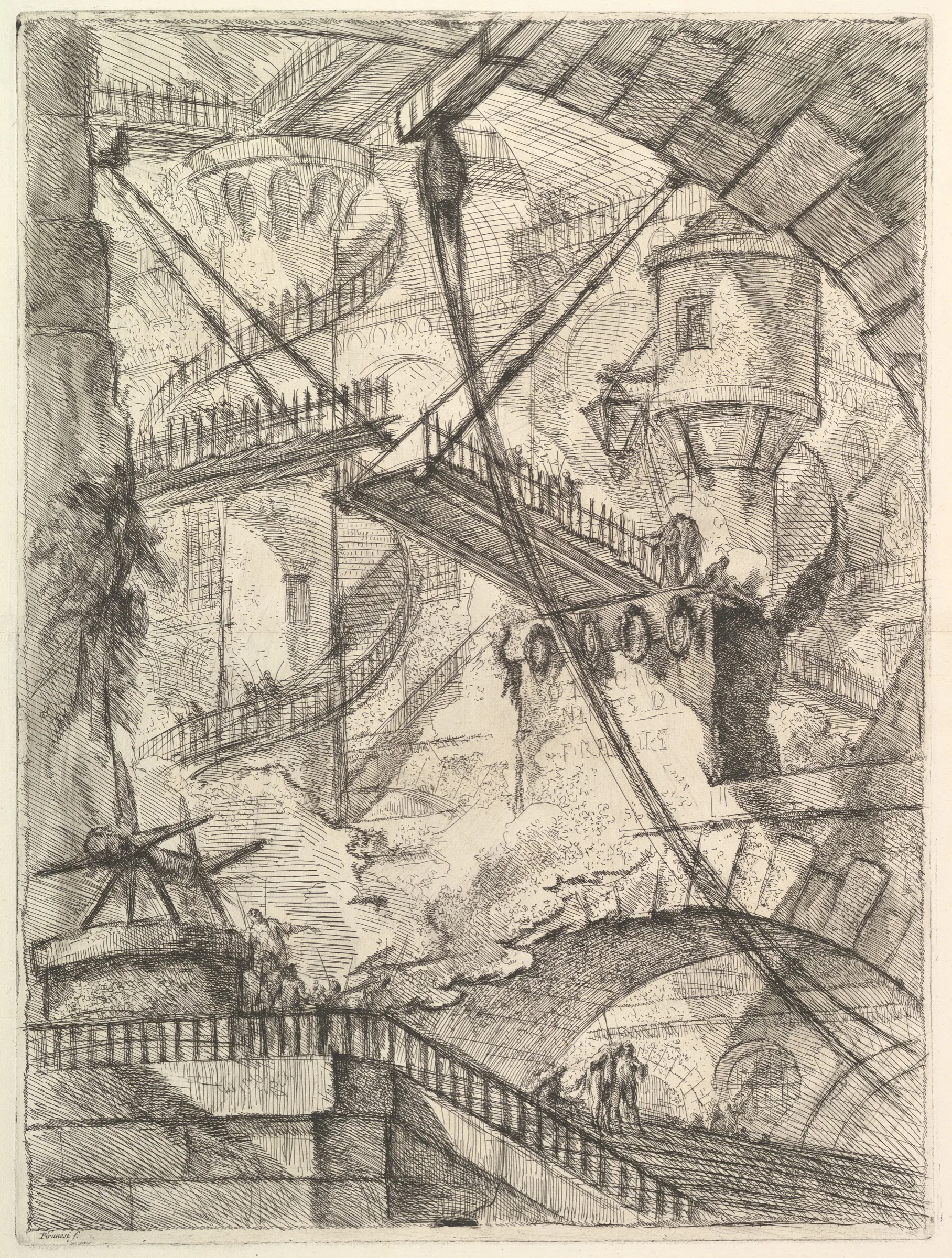
Giovanni Battista Piranesi, The Drawbridge, from Carceri d’invenzione, c. 1749–50. The Metropolitan Museum of Art. Public domain.
The uncomfortable part
Air is not alone.
OpenAI already provides parallel tasks, separate workspaces and review. GitHub Copilot CLI now lets developers choose models from Anthropic, OpenAI and Google inside an environment that provides planning, tool use, repository memory and review. GitHub is building its own multi-model working environment.
So “control” is not a durable advantage by itself. It is becoming part of the category.
JetBrains’ credible advantage may sit deeper: its accumulated ability to understand large software projects, its relationship with professional developers and its ability to connect AI work to the tools those developers already rely on.
But those are advantages Air still must convert into outcomes.
Does it reduce the total time spent checking AI-generated work? Does it prevent more mistakes? Does using several assistants create useful parallel progress, or simply give the developer more material to review? Is Air meaningfully better than using those assistants directly?
More production can create more risk
This matters because AI can increase the amount of work produced without improving the system receiving that work.
Google’s 2025 DORA research drew on nearly 5,000 technology professionals. It found that greater AI use was associated with higher software-delivery throughput and better product performance, but continued to have a negative relationship with software-delivery stability. Thirty percent of respondents reported little or no trust in AI-generated code. The report’s wider conclusion was that the return comes from the surrounding workflow, testing and feedback systems—not the AI tool alone. The faster production moves, the more visible the weaknesses around it become.
A company can produce more changes while becoming less confident about what those changes will break.
This is why review, containment and accountability matter. But their presence inside a product is not enough. JetBrains still has to show that Air makes the work easier to judge and safer to accept than going directly to the agents themselves.

Rembrandt van Rijn, The Sampling Officials of the Amsterdam Drapers’ Guild, Known as ‘The Syndics’, 1662. Rijksmuseum. Public domain.
The founder lesson
This story is not only about software.
Many founders are about to face the same strategic pressure. The capability at the centre of their offer may become cheaper, easier to access and available from the same small group of AI suppliers.
When that happens, adding AI is not a strategy. Every competitor can eventually rent similar intelligence.
The useful question is what your business owns around it.
Do you own the place where the customer begins the task? Do you hold the context that makes the output relevant? Do you reduce the time needed to inspect it? Do you stop mistakes before they reach the customer? Does your product remain useful if the underlying AI model is replaced next month?
JetBrains’ answer appears to be a connected system: Air for assigning and reviewing individual AI tasks, its established developer tools for deeper hands-on work, and the emerging JetBrains Central platform for company-wide governance, execution and oversight. As of July 2026, JetBrains had begun a gradual rollout of the first Central capabilities to business customers.
Whether JetBrains wins this battle is unclear. Air is still early, and its competitors understand the same shift.
But the business lesson is clear. When the intelligence can be rented, access to intelligence is not the durable advantage. The business has to own a part of the surrounding work that reduces a real cost: confusion, review time, risk or failure.
Then it has to prove it.